


Penstock Steel Liners
Penstock Steel Liners are fabricated steel pipes or shells installed inside concrete or rock tunnels to safely convey water under pressure from the reservoir to turbines, surge shafts.
The liner provides a watertight passage and resists internal pressure, thereby protecting the surrounding concrete or rock from seepage and structural stress.
Penstock liners are essential components in hydropower projects, pumping stations, and water conveyance systems where high-pressure flow must be maintained efficiently and safely.
Function:
The purpose of a steel liner is to contain and transmit water under high pressure without leakage. It also absorbs tensile stresses that cannot be resisted by the surrounding concrete or rock. The liner ensures smooth water flow, minimizes friction losses, and increases overall hydraulic efficiency.
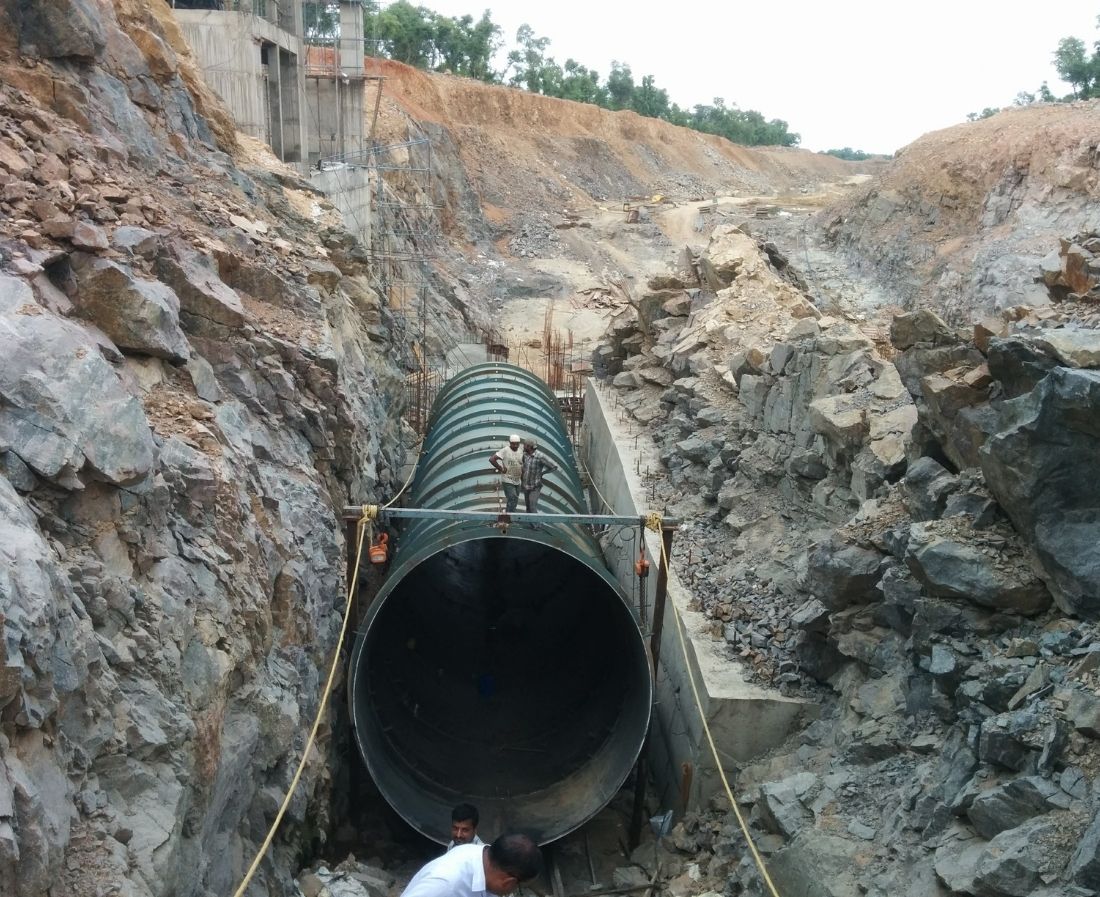

Main Components
- Steel Shell / Liner Plates: Rolled and welded steel plates forming the pressure-tight shell.
- Longitudinal and Circumferential Welds: Provide structural continuity and watertight joints.
- Stiffeners Rings: Transfer water pressure from liner to surrounding concrete.
- Expansion Joints: Allow for thermal movement and pressure variations.
- Manholes: For inspection, maintenance.
Materials Used
- Mild Steel (IS 2062) or High-Strength Structural Steel (IS 2002 / ASTM A537 / ASTM 517).
- Plate thickness typically starts from 8 mm to 60 mm, depending on head pressure and diameter.
- Internal surface coated with coal tar epoxy paint or bituminous paint for corrosion and abrasion resistance.
- External surface coated with coal tar epoxy or bituminous paint to prevent corrosion during concreting.
Manufacturing & Installation
- Fabricated in shop using rolled plates, automatic welding, and ultrasonic testing (UT) of joints.
- Pre Heat & Post Heating of selected material as per ASME Sec. IX.
- Liners are transported in segments and joined by site welding.
- Stiffeners are welded as per drawing before concreting.
- After installation, hydrostatic pressure testing is carried out to ensure leak-tightness.
Advantages
- Ensures complete water-tightness under high pressure.
- Protects concrete or rock surface from erosion and seepage.
- Reduces friction losses and improves hydraulic efficiency.
- Allows for safe operation and longer life of penstock systems.
- Can be designed for varying head and flow conditions.
Applications
- Hydropower and pumped storage projects
- Dam outlet works and surge shafts
- Pumping stations and irrigation tunnels
- Pressure conduits in water supply systems
Design Considerations
- Internal water pressure and external load
- Hoop stress and longitudinal stress in liner
- Anchor spacing and interaction with concrete
- Corrosion protection system
- Fabrication tolerance and site weld inspection



